
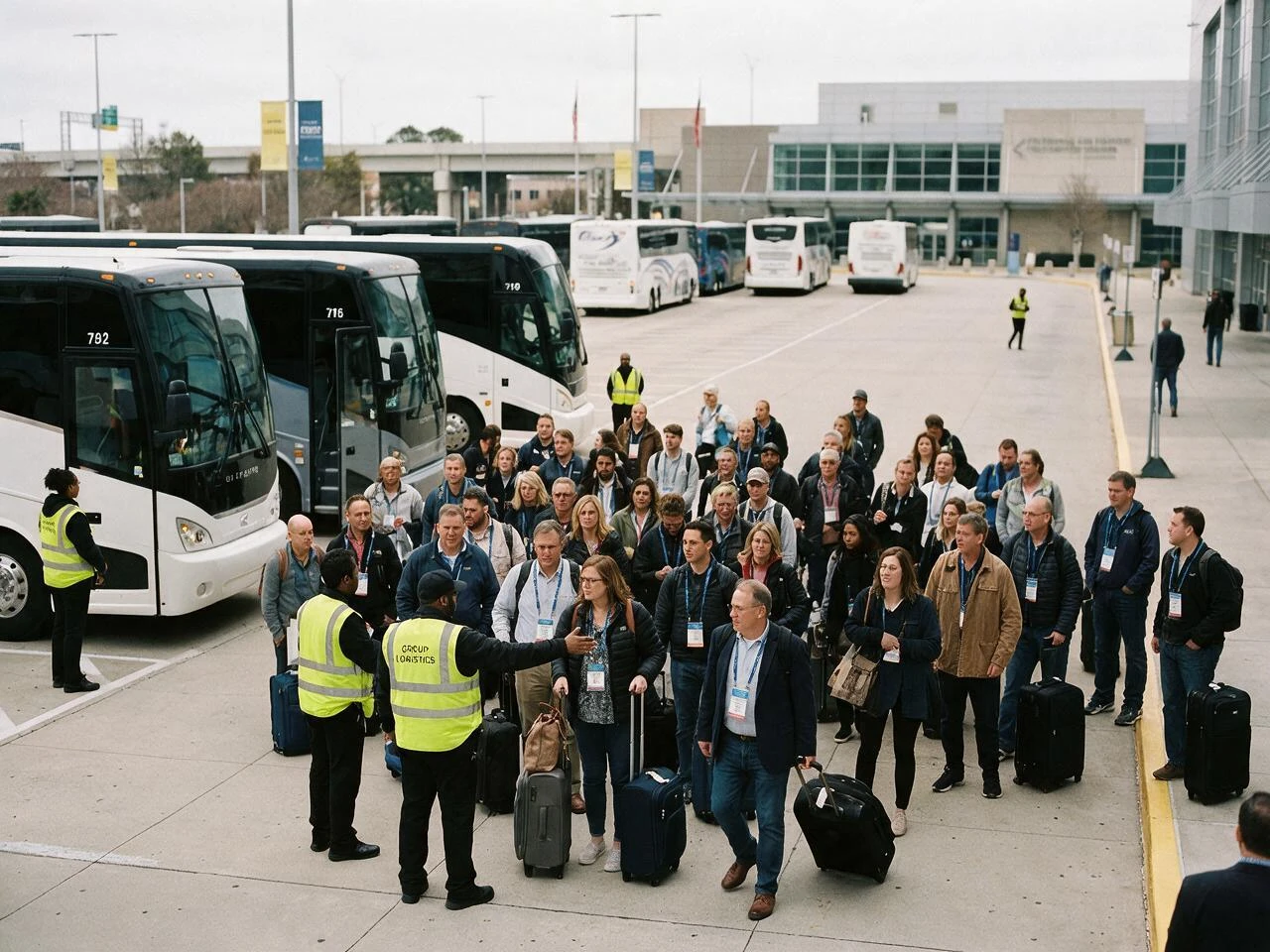
A conference organizer books a keynote speaker, a venue, and catering for 300 guests, then almost forgets one detail until the week before: how does everyone actually get from the airport to the hotel, and from the hotel to the venue, on time. That detail is where event transfer logistics stops being an afterthought and becomes the difference between a smooth event and a chaotic one.
Below 20 attendees, transportation is simple. A few sedans or a single van handle it. Past 50 attendees, the math changes entirely. Fleet size, scheduling, and contingency planning all become interconnected problems, and getting one wrong tends to break the other two.
Why 50 Attendees Changes the Math
Somewhere around the 50-person mark, ad hoc transportation stops working. Attendees arrive from multiple hotels, multiple flights, and multiple time zones, and a handful of rideshares simply cannot move that many people at once without splitting the group and scattering arrival times.
Event transfer logistics at this scale requires treating transportation as its own workstream, not a line item added after the venue and catering are locked in. The transport plan needs to build around the event agenda itself: session start times, keynote windows, and meal breaks all dictate when vehicles need to be in position.
Where Capacity Planning Goes Wrong
Capacity mismatches cause most of the early failures. Booking a 40-passenger coach for a group of 15 wastes money. Booking three sedans for a group of 50 wastes time and creates six separate pickup windows instead of one.
The right event transfer logistics plan starts by matching vehicle capacity to actual headcount, then building in enough margin for stragglers and late checkouts. This is not a scaled-up version of the same booking process used for smaller groups. It is a different operational category, and treating it that way from the start separates events where transportation runs invisibly from events where it becomes the story attendees tell afterward.
Fleet Coordination: Matching Vehicles to Group Size
Vehicle selection at this scale is rarely a single choice. A group of 50 to 80 people usually needs a mix: one or two full-size motor coaches for the bulk of the group, paired with a Sprinter van or two for staggered arrivals and VIP speakers who cannot wait for a shared departure.
Coach capacity typically runs between 40 and 56 seats, so a group of 60 might need two coaches running close to full, or one coach plus a van covering the overflow. Groups above 100 usually shift toward a shuttle loop model instead of a single fixed departure, since no single fleet can move that many people in one wave without a long wait at the pickup point.
Handling VIPs and Staggered Arrivals
Executive attendees complicate the fleet mix further. Keynote speakers, board members, or VIP guests often need dedicated vehicles that bypass the general shuttle schedule, since their itineraries rarely align with a group departure time. A well-built event transfer logistics plan accounts for this from the start, rather than retrofitting a VIP exception after the schedule is already set.
Airport transfers add another layer of complexity. Flights rarely land in one neat batch, so a group of 60 arriving across a four-hour window needs a different vehicle plan than the same group departing together for a single opening session. Matching fleet size to arrival patterns, not just total headcount, keeps vehicles from sitting idle or attendees from waiting far longer than they should.
Scheduling: Waves Versus Loops
Two scheduling models dominate large-group transfers, and choosing the wrong one creates most of the delays organizers see on event day.
A wave model moves the whole group at once, departing at a single scheduled time. It works well for airport transfers and opening sessions, where everyone needs to arrive together. A loop model runs vehicles continuously between two points, letting attendees board whenever they are ready. Loops suit multi-day conferences with staggered session breaks, where forcing everyone onto one schedule creates unnecessary congestion.
A rigid wave departure feels efficient on paper but frustrates anyone who arrives at the pickup point a minute late. A loop model trades some coordination complexity for flexibility that attendees notice and appreciate.
Why Buffer Time Matters
Buffer time is the detail most schedules underestimate. Loading a coach with 50 people, luggage included, routinely takes 10 to 15 minutes longer than organizers expect, and that gap compounds across multiple pickup points.
Building that margin into the event transfer logistics schedule up front avoids the cascading delays that turn a five-minute overrun into a missed session.
The Coordination Layer: Dispatchers and Real-Time Tracking
Past roughly 50 attendees, informal coordination breaks down fast. Someone needs to know, in real time, which vehicles have loaded, which pickups are running behind, and which attendees are still unaccounted for.
A dedicated dispatcher, paired with real-time vehicle tracking, replaces the guesswork that causes most large-event transportation failures. The dispatcher becomes the single point of contact between drivers, venue staff, and the event organizer, catching problems before attendees notice them.
Keeping Attendees Informed
Clear attendee-facing communication matters just as much as internal coordination. A shared schedule with specific pickup locations, landmark references, and a firm departure time reduces the number of last-minute questions dispatchers have to field mid-event.
Event transfer logistics that rely purely on word-of-mouth communication tend to fall apart exactly when the group gets large enough to need structure most.
Contingency Planning: When the Schedule Breaks
No transfer schedule survives contact with a delayed flight, a traffic closure, or a session that runs 20 minutes long. The organizers who avoid a visible scramble are the ones who planned for that before event day, not during it.
A written alternate route, agreed with the transportation provider in advance, lets dispatchers redirect vehicles the moment traffic or venue access changes without waiting on the organizer. Holding one vehicle in reserve, rather than booking fleet capacity to the exact headcount, absorbs the inevitable no-show, late arrival, or mechanical issue without cascading into the rest of the schedule.
Weather and traffic are the two disruptions event transfer logistics plans handle worst when left unaddressed. Building a known delay threshold into the schedule, say a 15-minute buffer before a session is affected, gives the dispatcher room to adjust before a small delay becomes a missed keynote.
Conclusion
Event transfer logistics for groups of 50 or more is not a scaled-up version of booking a few cars. It is a distinct operational problem, one that treats fleet coordination, scheduling structure, and contingency planning as three parts of the same system rather than three separate tasks. Organizers who build the transport plan around the event agenda, not after it, are the ones whose attendees never notice the logistics at all. That, in the end, is the actual goal: transportation that works so well nobody has to think about it.
Ready to automate business travel?
GetOffers — AI platform for corporate travel management. Save 15–30% on business travel.
Related posts

Virtual Corporate Cards: How Companies Are Closing Expense Leakage
Virtual corporate cards expense leakage prevention works by locking every charge to a booking before it happens. Here's the mechanics behind the shift

Corporate Travel Cards 2026: Virtual vs Physical
Virtual cards cut costs by 23% compared to physical ones. We break down real numbers, hidden fees, and use cases for travel managers in 2026.

Right-Time Communication in Travel Management 2026
How timely notifications reduce business travel risks by 34% and boost employee satisfaction. Practical scenarios and technologies for travel managers.

Business Travel Reporting in 1C: Integration 2026
Automate business travel reporting in 1C through API integration with a booking platform. Cut document processing time by 4× and eliminate accounting errors.

T&E Expense Automation: 9 Control Features in 2026
Nine essential T&E automation features for financial control of business travel: from pre-approval to audit. Implementation examples and ROI metrics.

Employee Business Travel Expense Reimbursement 2026
Reimbursement timelines for business travel expenses, mandatory documentation, and common accounting errors. Practical solutions for companies with regular travel.