
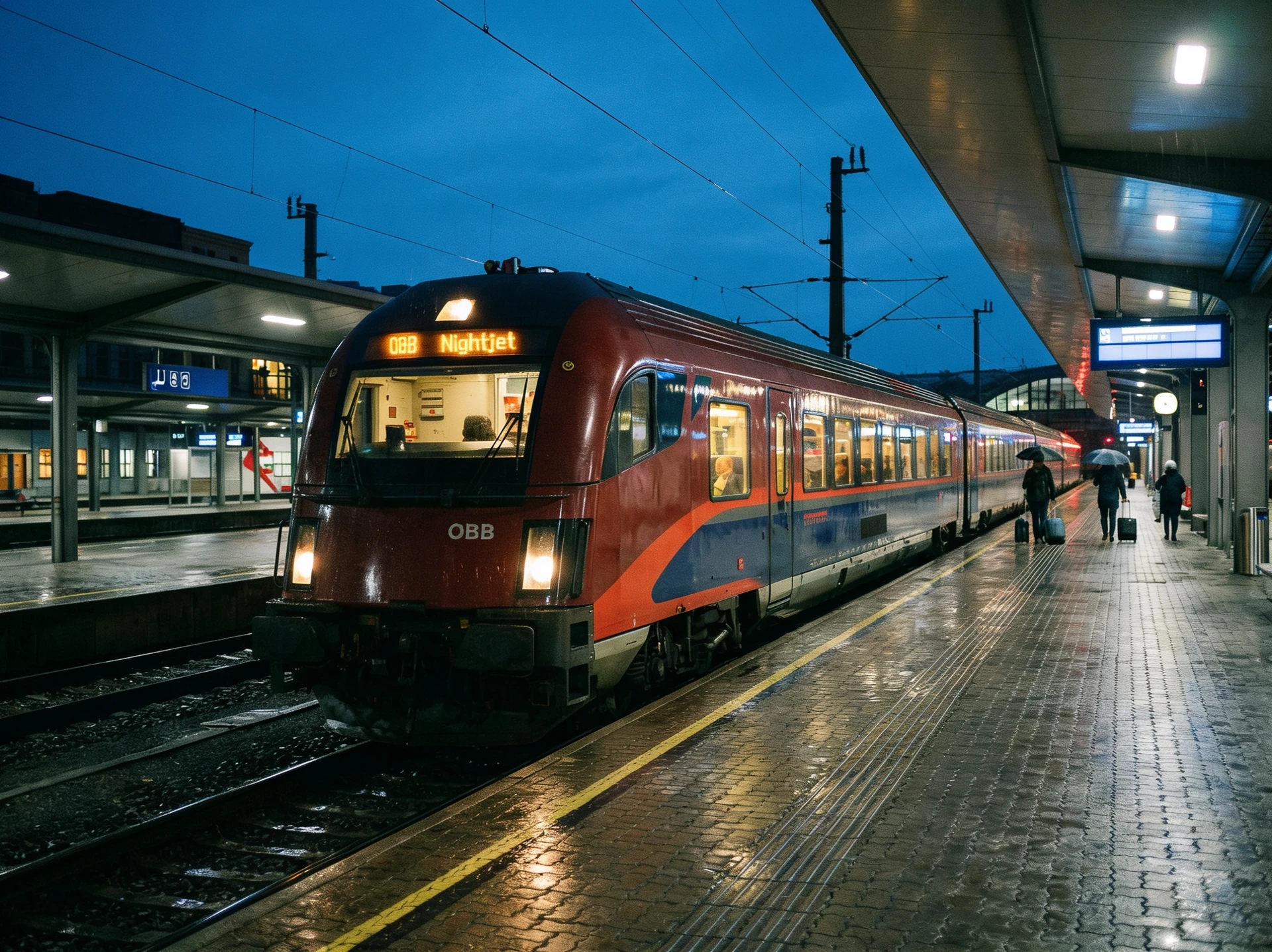
A finance director in Amsterdam books a Tuesday meeting in Milan. Five years ago, the only sensible option was a short-haul flight, an airport transfer, and a hotel room booked the night before. Today, there is a third option: board a sleeper train in the evening, work through dinner, sleep through the Alps, and step out in Milan the next morning without ever seeing an airport. That shift sits at the center of the European night trains business travel conversation now reshaping how companies book their teams across the continent.
The revival is real, but it is not simple. Night train capacity is expanding fast in some corridors and collapsing in others, often in the same year. A route that looked promising in January can lose funding by December, and a corridor written off a decade ago can reopen with newer, faster rolling stock. For corporate travel managers, understanding which trend applies to which route has become a genuine planning problem, not just a curiosity.
Why Night Trains Are Back on the Map
The numbers behind this revival are striking. Europeans travelled 443 billion kilometres by train in 2024, a 5.8 percent increase over the previous year, and overnight routes are a growing share of that total. New or restored sleeper services are launching through 2026, including a reinstated Paris-Berlin route and a new Amsterdam-Milan line running through the Swiss Alps.
The environmental case helps explain the momentum behind European night trains business travel planning. A flight from Amsterdam to Rome produces roughly 150 to 200 kilograms of CO2 per passenger. The equivalent overnight train journey produces closer to 15 to 20 kilograms, a reduction of around 90 percent. For companies under pressure to report lower travel emissions, that gap is difficult to ignore.
Public support reinforces the trend. A 2025 survey of more than 11,000 people across Europe and North America found that roughly two-thirds of Europeans support banning short-haul flights wherever a workable train alternative exists. That sentiment is already shaping policy, not just personal preference.
The Policy Push Behind It
Regulation is doing as much work as consumer demand. France has moved to prohibit domestic flights on routes where a direct train connection can complete the journey in two and a half hours or fewer, provided the service runs with sufficient daily frequency. Austria took an earlier step in the same direction, effectively phasing out short domestic flights that could be replaced by a three-hour train journey.
These rules matter well beyond national borders. Multinational companies with EU-based teams increasingly write similar restrictions into their own travel policies, sometimes going further than the law requires. A European night trains business travel mandate, once limited to a handful of government agencies, is becoming standard language in corporate travel guidelines across the continent. Employees booking flights on covered routes may need to justify the choice, or simply won't be reimbursed for it.
The EU's broader climate targets add another layer of pressure. Brussels has set a goal of carbon neutrality by 2050, and rail travel produces significantly less CO2 per passenger than an equivalent short-haul flight. Industry groups are pushing for a much larger high-speed network by that date, arguing that better infrastructure would let rail carry the majority of long-distance passenger traffic. Corporate sustainability reporting requirements are starting to track in the same direction, giving travel managers an additional reason to favor rail wherever the option genuinely exists.
Comfort, Connectivity, and the Business Traveler
The case for night trains used to rest almost entirely on cost and romance. That has changed. Newer rolling stock, including the ComfortJet trainsets entering service on routes like Amsterdam-Milan, includes onboard bistros, dedicated workspaces, and high-speed Wi-Fi built specifically with business travelers in mind.
City-center arrival remains the strongest practical argument. A traveler stepping off a sleeper train in central Milan or central Berlin skips the airport transfer, the security queue, and the taxi ride that eats into a flight's apparent time advantage. Add an evening departure and a morning arrival, and the night train can preserve a full working day at both ends of the trip, something a same-day flight rarely manages once transfer time is counted.
For teams weighing European night trains business travel against a flight, the total door-to-door comparison often favors the train more than the raw journey time suggests. A three-hour flight can consume five or six hours once check-in, security, and ground transport are added. An eight-hour overnight train, timed around a traveler's sleep schedule, can feel shorter in practice even though it is longer on paper.
Where Night Trains Still Fall Short
The revival is genuinely uneven, and corporate travel planners need to see past the headlines. Funding remains fragile. The ÖBB Nightjet service between Paris and Vienna was cancelled for 2026 after the French government withdrew support, and a planned Basel to Copenhagen route was scrapped by the Swiss Parliament even after tickets had gone on sale.
Infrastructure is a deeper constraint. Much of the current night train fleet cannot access high-speed lines because older, locomotive-hauled carriages are too heavy for track built for lighter trains like the TGV. That forces many sleeper services onto slower, indirect routings, undercutting the time advantage that makes European night trains business travel attractive in the first place.
Geographic coverage is also thin. Southern and eastern Europe have far fewer international overnight routes than the northern and western corridors, leaving large parts of the continent without a realistic rail alternative to flying. For a company with offices scattered across a dozen countries, night trains solve the Paris-Berlin problem convincingly but leave the Warsaw-Lisbon problem untouched.
What This Means for Corporate Travel Policy
None of this makes night trains a wholesale replacement for short-haul flights, and framing the shift that way overstates the threat to corporate air travel. It makes more sense as a route-by-route calculation. On corridors under 1,000 kilometres, with direct high-speed track and reliable overnight service, the case for rail is strong and growing stronger. On routes without that infrastructure, or where funding remains politically uncertain, flying is still the more dependable choice.
Travel managers building policy around European night trains business travel should treat regulation as the floor, not the ceiling. France's flight restrictions and similar rules elsewhere set a legal minimum, but the sustainability, cost, and time arguments already push many corporate travelers toward rail even where no ban applies. Building route-specific guidance, rather than a blanket rule, keeps the policy realistic as the network itself keeps shifting.
Conclusion
Europe's night trains are not quietly replacing corporate air travel, and they are not a passing trend either. The picture is more specific than either narrative allows. Where high-speed track, stable funding, and modern rolling stock line up, the European night trains business travel case becomes genuinely competitive with flying, on emissions, on comfort, and increasingly on total travel time. Where any of those three pieces is missing, the plane still wins. For corporate travel policy, the sensible response is not a single continent-wide rule but a route map, updated as often as the network itself changes.
Ready to automate business travel?
GetOffers — AI platform for corporate travel management. Save 15–30% on business travel.
Related posts

Private Aviation for Executives: When Charter Beats Business Class
A break-even look at the executive travel private jet cost-benefit case: when charter beats business class, and when it still doesn't

The Hidden Cost of Conference Travel: Why Event Delegations Need Their Own Rulebook
Business travel hit $1.57 trillion in 2025, and conferences are driving the spike. See why standard travel policies fail delegations — and the six fixes that work

Per Diem vs Actual Expense: Which Saves More in 2026
Per diem or actual expense reimbursement — which model cuts costs and simplifies accounting in 2026? We break it down with real numbers and examples for companies with 50+ employees.

Business Trip Budget Optimisation: 7 Strategies for 2026
Cut business travel costs by 18–34% without sacrificing quality. Proven budget optimisation strategies with concrete figures and implementation examples.

Per Diem vs Actual Expense: Choosing a Reimbursement Method in 2026
Comparing per diem and actual expense: tax implications, hidden accounting costs, and real savings for companies with varying business travel volumes.

One-Day Business Trips: Processing, Expenses & Accounting
A breakdown of documentation, per diem calculations, and tax nuances for one-day business trips without overnight stays. Ready-made checklists and examples for accounting.